THE WYE VALLEY |
|
Harlan Hague |
"Eardisley has a sweet little parish church, and you should see it," an English friend told me. I did and saw more than a sweet church; I found a national treasure.
Just inside the south porch door of the church is a stone Norman font, dating from 1160 A.D. The figures carved in relief on the bowl, with their pointed beards and wearing quilted vests and conical hats, are in almost perfect condition.
Construction of the church was begun during the reign of Richard I, Coeur de Lion, the Lion-Hearted,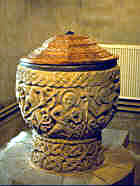 when
the religious zeal of the Crusades gripped the land. Successive
generations added to the structure of the church and furnishings, but
the blend is so harmonious that the casual visitor is unaware of the
eight hundred years of modification.
when
the religious zeal of the Crusades gripped the land. Successive
generations added to the structure of the church and furnishings, but
the blend is so harmonious that the casual visitor is unaware of the
eight hundred years of modification.
About fifteen miles west of Hereford, Eardisley is one of the many quiet little villages in Britain's Wye Valley that sees few foreign visitors in comparison to other regions. It is popular with British vacationers, but foreigners motoring between Oxford and the Cotswold Hills and Wales usually pass it by.
Located on the much-contested border between England and Wales, this is a land of castles and fortified houses. A good representation of both is Tretower Court and Castle, about three miles northwest of Crickhowell, between Abergavenny and Brecon.
This is one of the best examples in Britain of the progression of castle-building, from the earth and timber motte and bailey of the eleventh century through the additions of stone wall and tower of the next two centuries. The construction of the defended house nearby in the early fourteenth century illustrates as well the transition from the medieval age of local warfare to a more peaceful and comfortable life as a strong monarchy reduced the threat of internal strife. Two more castles of considerable interest in the area are at Raglan and Goodrich.
Don't leave the southern valley without a visit to the romantic ruins of Tintern Abbey, a few miles north of Chepstow. The Gothic abbey was built in the early twelfth century for the Cistercian Order. Driving northward, stop at Ross-on-Wye. Ross is an attractive little town with Tudor houses and an interesting seventeenth-century Market Hall of local red sandstone. Traffic in the narrow streets can be frightful, so park your car as quickly as possible and walk.
By the way, you will need a car for touring the valley. Use a
detailed map because distances are short. Stay off the motorways
(freeways) for obvious reasons; stay off the unnumbered secondary roads
as well. Often single-track, they are usually unrewarding because of
high hedges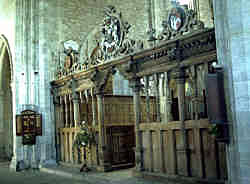 that you can't see over, and terrifying to drive because of blind
curves.
that you can't see over, and terrifying to drive because of blind
curves.
Continuing northward, visit Dore Abbey, just off the A465, about half way between Abergavenny and Hereford. This Cistercian abbey dates from the twelfth century. Though not as significant historically as Tintern Abbey, Dore is more interesting. While Tintern Abbey is a magnificent ruin, Dore Abbey is a functioning parish church which is, at the same time, a melancholy example of a once-grand structure progressing steadily toward ruin.
The best part of the Wye region is a semi-circle north of Hereford, beginning at Hay-on-Wye. This busy little Welsh border town claims to be the "World's Largest Bookshop," with about two dozen shops offering over a million volumes of mostly secondhand and antiquarian books. For a splendid panorama of the valley, drive up the peak east of the town where you will share grassy hillsides with sheep, ponies and hang-gliders.
Drive eastward now through the lovely villages of Eardisley, Weobley, Pembridge, and Eardisland. Each has attractive black-and-white, half-timbered shops and houses. Weobley, a charming medieval village, has a particularly pretty square. A nice lunch stop is The Gables where one can sit in the timbered dining room before the fourteenth century stone fireplace.
 Continuing
eastward, stop for tea in Leominster, notable for half-timbered houses
and red brick Georgian buildings. Drive past Bromyard two or three miles
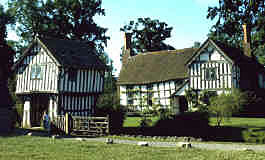
to reach Lower Brockhampton Court, a National Trust property. This
half-timbered, black-and-white manor house and gate house, in a rural
setting beside a pond, is a delight and should not be missed.
Continuing
eastward, stop for tea in Leominster, notable for half-timbered houses
and red brick Georgian buildings. Drive past Bromyard two or three miles
to reach Lower Brockhampton Court, a National Trust property. This
half-timbered, black-and-white manor house and gate house, in a rural
setting beside a pond, is a delight and should not be missed.
Drive southward to Ledbury, renown for its many half-timbered buildings and a unique seventeenth century arcaded Market Hall. The view up Church Lane toward the twelfth century church, also worth a visit, is particularly pleasing.
The best way to see the valley is to tour from a base. Bed &
Breakfasts are everywhere. We stayed at tiny Kilpeck, only about eight
miles southwest of 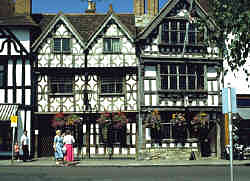 Hereford
on the A465, though the feeling is one of being deep in the countryside.
Our B&B was The Priory, one of the most delightful B&Bs I have
found anywhere in Britain. The original priory was completed in the
early twelfth century to house Benedictine monks. The present building,
set in its own grounds and itself an architectural gem which is
registered, dates from the early 1600s. Call Jean Pike at Wormbridge
(098121) 366. Mrs. Pike serves the best breakfast in all of England, and
a non-cooked breakfast at that, at my request.
Hereford
on the A465, though the feeling is one of being deep in the countryside.
Our B&B was The Priory, one of the most delightful B&Bs I have
found anywhere in Britain. The original priory was completed in the
early twelfth century to house Benedictine monks. The present building,
set in its own grounds and itself an architectural gem which is
registered, dates from the early 1600s. Call Jean Pike at Wormbridge
(098121) 366. Mrs. Pike serves the best breakfast in all of England, and
a non-cooked breakfast at that, at my request.
Have a pint and dinner in nearby Much Dewchurch at The Black Swan, which claims to be "the oldest licensed property in the kingdom." Attesting to its age and location, the eleventh-century inn features arrow windows and watch towers.
Back in Kilpeck, drive past the pub to see the church. While the village has Saxon origins, the richly-decorated church was built by Normans in the mid-twelfth century. The most notable feature of the church is the magnificent carved stone portal of the south doorway. The scene depicts the creation and the temptation and fall of man. Two figures on the left side are thought to be a Norman sculptor's representation of Welsh warriors.
The Wye Valley above all should be seen at a slow pace. Stop for coffee in the morning, picnic at a grassy spot with a view, and enjoy a cream tea in the afternoon.
|
Caveat and disclaimer: This is a freelance travel article that I published some time ago. Some data, especially prices, links and contact information, may not be current. |
|
|
|
|