AIGUES-MORTES |
|
Harlan Hague |
"Our eyes set
upon Aigues-Mortes . . .
a jewel carefully set in a case of stone."
Alexandre Dumas's tribute to Aigues-Mortes still rings true, though the town's name in English, "Dead Waters," is less poetic. Located in the heart of the marshy Camargue region on France's Mediterranean coast, Aigues-Mortes is a completely walled town that has changed little in appearance since its glory in the Middle Ages.
The town was founded by Louis IX in 1241. Before that date, all of the ports on the south coast of present-day France were owned by the king of Aragon, the Germanic emperor, and the Pope. With no access to the sea, the French did not share in the lucrative Mediterranean trade, nor were they guaranteed free departure for the crusades. This situation changed when Louis obtained the flatland of ponds and marshes from an order of monks, whose Psalmody Abbey on the site dated from the fifth century.
Recent archaeological excavations of the ruined abbey have uncovered even earlier ruins dating to the Gallo-Roman era.
Aigues-Mortes was an immediate success. Settlers were attracted by Louis's offer of exemption from most taxes. With the construction of his opening to the sea now underway, Saint Louis departed in 1248 for a crusade to Egypt. This seventh crusade was largely organized by Louis, and its members were mostly French.
The new port quickly became important in maritime trade and a source of revenue for its proprietor. Louis began construction of the town walls in 1266, but he was not to see them finished. He died in 1270 on his second crusade en route to Tunis. The walls were not completed until almost the end of the century. By that time, the population of the town had risen to 15,000, three times today's population. At that point, Aigues-Mortes's fortunes were at their peak, and began to decline. The town's eclipse began with the rise of Marseille. It was completed as the basin, which fronted on the sea, was gradually filled by silt deposited by the Rhône River. It never recovered.
Modern visitors to Aigues-Mortes, now about five miles from the sea, will rejoice at what was calamity for the fourteenth century inhabitants. As rival ports rose, and access to the sea was blocked, trade decreased, and townsmen moved away. The town stagnated, but it did not die. It was maintained as a fortified city, potentially important for coastal defense. Since there was nothing in the following centuries to attract new inhabitants, the town did not grow, and the walls were not torn down. Today, visitors wander about in a virtually-intact thirteenth century fortified town.
The walls are particularly interesting. The land side was protected by a sea-water
moat, now 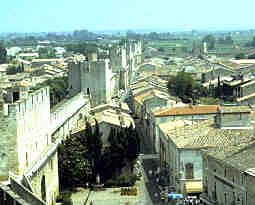 unfortunately filled. Three corners of the rectangular wall are
protected by towers of different design and size that are almost separated from the wall
to give defenders a clear shot at attackers. The Constance Tower, constructed 1242-1248,
is unique. Located at the northwest corner of the town, it was completely separated from
the wall. Saint Louis initially intended that the tower be the sole defense of
Aigues-Mortes. With walls sixteen feet thick, the structure, in its design more keep than
tower, contained rooms used by the king during his visits to Aigues-Mortes. The weight of
the massive tower was so great that the foundation was laid on a platform of huge oak
pillars driven through the marshy soil to the harder earth beneath.
unfortunately filled. Three corners of the rectangular wall are
protected by towers of different design and size that are almost separated from the wall
to give defenders a clear shot at attackers. The Constance Tower, constructed 1242-1248,
is unique. Located at the northwest corner of the town, it was completely separated from
the wall. Saint Louis initially intended that the tower be the sole defense of
Aigues-Mortes. With walls sixteen feet thick, the structure, in its design more keep than
tower, contained rooms used by the king during his visits to Aigues-Mortes. The weight of
the massive tower was so great that the foundation was laid on a platform of huge oak
pillars driven through the marshy soil to the harder earth beneath.
The tower was originally surrounded by a moat, part of which can still be seen. Its height, 105 feet, was sufficient for lookouts to spot ships on the sea that were trying to evade the payment of taxes. The panoramic view from the top--after climbing fifty-three steps--is still rewarding. With the decline of Aigues-Mortes, the tower served as a prison for five hundred years, most notably to house Protestant Huguenots during the persecutions of the eighteenth century.
The center of the town, a sunny little square, predictably named Place St. Louis and
graced by his statue, is a pleasant place for lunch. The restaurants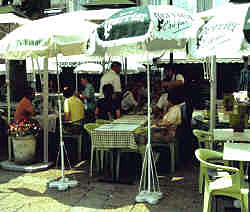 that line one side of the square feature outside tables shaded by trees and umbrellas.
After lunch, visit Our Lady of the Sands church, just opposite, one of the first buildings
constructed in the town. Indeed, it may have predated the town. The main altar is a table
from the Psalmody Abbey. The L'Hotel de Ville, also on the square, is a fine example of a
typical town hall of the seventeenth and eighteenth centuries.
that line one side of the square feature outside tables shaded by trees and umbrellas.
After lunch, visit Our Lady of the Sands church, just opposite, one of the first buildings
constructed in the town. Indeed, it may have predated the town. The main altar is a table
from the Psalmody Abbey. The L'Hotel de Ville, also on the square, is a fine example of a
typical town hall of the seventeenth and eighteenth centuries.
Two seventeenth-century churches, within three blocks of the square, are worth visiting. The Chapel of the Grey Penitents has a striking altarpiece. A number of large eighteenth-century paintings decorate the Chapel of the White Penitents. Government Hall, near the Constance Tower, dates from the sixteenth century. On the roof of the hall is a turret which defends the bridge that runs from the wall across the moat to Constance Tower.
The only local industry of note, the extraction of salt from sea water, has been practiced here for over two thousand years. Phoenicians and Romans labored at the same task on the same site.
The inhabitants of Aigues-Mortes have found novel uses for the salt. In the fifteenth century, the town was attacked and occupied by a force of Burgundians. When the town was retaken, the Burgundians were all killed. Faced with disposing of the mountain of corpses, and fearing disease, the bodies were piled into the tower and covered with salt. The tower has since been called the Burgundians Tower.
During the peak of the summer season, the main streets can be busy, though not oppressively so. A stroll down side streets can be most rewarding, especially if you have stayed overnight and are up before the arrival of the day trippers.
For information on Aigues-Mortes, the Camargue, and Provence in general, contact the French Government Tourist Office, 610 Fifth Avenue, New York, NY 10020, telephone 212/757-1125. For more specific information, including hotels, restaurants and events, write to: Office Municipal du Tourisme, Cloître des Capucins, Place Saint-Louis, B.P. 32, 30220 Aigues-Mortes, France. Telephone 66-53-73-00.
|
Caveat and disclaimer: This is a freelance travel article that I published some time ago. Some data, especially prices, links and contact information, may not be current. |
|
|
|
|