ORADOUR-SUR-GLANE: REMEMBER |
|
Harlan Hague |
|
There is a time for purely hedonist travel. Lying on a quiet beach in the warm sand can restore an exhausted body and drained spirit. But travel for pure pleasure can do little for the soul. Eventually one yearns for experiences that teach as well as entertain and restore. One summer, after a week of walking in the heady atmosphere of the Swiss Alps and another week languishing in the dreamy landscapes of the Dordogne, I visited Oradour-sur-Glane. I will not soon forget Oradour. Millions of Americans have toured the invasion beaches of Normandy and seen the monuments to the success that followed the Allied landings in June 1944. By commemorating the heroic feats and suffering of the brave men who participated in the assault, the monuments and museums leave one with a sense of victory and glory. Not so Oradour. There, one sees only tragedy. The reason for visiting Oradour is emblazoned on the doorway to the ruined village: "Souviens-toi: Remember." In 1944, Oradour townspeople would have heard of the allied landing in Normandy within a day of that momentous June 6. But the invasion beaches were far away, and Oradour remained quiet. That would change shortly. The Resistance had been warned of the invasion and now stepped up their actions to delay the movement of German forces to Normandy. On June 7, partisans blew up a railway bridge at Saint-Junien, ten kilometers from Oradour, in an attempt to slow the movement of a German SS armored division toward the front. German soldiers were killed. An officer, a personal friend of an SS commandant, was taken prisoner in another local Resistance action. As anxious as the Germans were to reach Normandy, they paused long enough to retaliate. It seems they first considered St. Junien for the symbolic reprisal. The German commander questioned the mayor. He asked if there were partisans in the town. The mayor answered that there were. How many, the German asked. The mayor exaggerated: at least eighteen hundred, he said. The German commander thought better of savaging St. Junien. The Resistance had been particularly effective of late, and the Germans must not delay their march to Normandy. Why Oradour was selected is still a mystery. Perhaps it was because the village was so quiet, so inoffensive, and there had been no rumor of partisans there. It was known, even among the French, as a peaceful isle. On the morning of June 10, German half-tracks of the Third Company of the SS regiment, "Der Führer," a unit of the "Das Reich" Second Panzer Division, entered the village, loaded with troops. Villagers found this very curious because Germans had seldom been seen here during the occupation. Other troops forced people in outlying hamlets into Oradour and then surrounded the village. Citizens were told to assemble on the fairground in the center of the village. It was to be a simple identity check, they were told. Some who had been apprehensive breathed a sigh of relief. The baker asked if he could return to his shop. He had bread in the oven. Don't worry, a soldier said, we'll take care of it. Soldiers entered schools, barns, shops, and homes, moving the occupants toward the village center. Soon hundreds of people stood in the open fairground, chatting. No one had seen such a large crowd here before. Presumably to facilitate the identity check, townspeople were separated. Men were herded into barns and garages. The women and children were crowded into the church. The slaughter began on signal, a pistol shot. Within minutes, the population of Oradour ceased to exist. Six hundred forty two men, women, and children. After machine-gunning their captives, the Germans closed the buildings and lit fires. The burning village became their crematorium. Only a handful escaped the carnage to tell their gruesome tales. General Charles de Gaulle, leader of the free French, visited the village later and decreed that the ruins be left as a memorial and a reminder. And so they have remained as they were in June 1944. My wife and I entered Oradour early on the morning of July 14, Bastille Day. A family of five entered just before us and walked slowly out of sight as we waited. The streets were empty. I have never seen war, and what I saw now was
disturbing. Roofless shells of buildings lined the We walked down the street. A sign on each
building identified the type of structure, who lived or worked
there, and in many cases, who died there. Leaving the church, we walked through the fairground where villagers had gathered to await death. The grassy field was empty now but for the rusted hulk of a car. We walked to the border of the field and looked back at the fairground and the town. Standing in the heart of the ruined village, it was still hard to imagine the atrocities that took place here.
Members of the SS who took part in the atrocities at Oradour were tried at Bordeaux in 1953, the same year as the inauguration of the new village of Oradour. The court pronounced verdicts of death and hard labor for the accused. Exactly one week later, they were free. Amid a furious national debate on the question of collective guilt and the fate of Alsatian participants who had been forced to serve in the German Army, the French Government had enacted a general amnesty law. In despair and rage, the people of new Oradour broke relations with the central government and refused to place the ashes of the victims in the new State memorial. The remains were deposited instead in a privately-financed memorial in the adjacent cemetery. Seventeen years passed before Oradour was reconciled with the state. The state's memorial was then made a museum to display articles found in the ruins. We visited the museum and walked to the adjacent
cemetery, the real memorial to the victims. The For the most impressive visit to the ruined Oradour, spend the night in new Oradour and go to the old village early. The new Oradour is a pleasant village of over 2,000 inhabitants and inviting shops, hotels and restaurants. A motto on the town brochure reflects the attitude of its people: "Ni haine - ni oubli." Neither hate nor forgetfulness. Oradour-sur-Glane is located sixteen miles northwest of Limoges on route N147. Write for information to the French Government Tourist Office, 610 Fifth Avenue, New York, NY 10020, 212/757-1125. The tourist office in Oradour, on the Place du Champ-de-Foire, telephone 55.03.13.73, is open from mid-June to mid-September, but it will respond to mail inquiries throughout the year. Write to: Syndicat d'Initiative, S.I.-87520, Oradour-sur-Glane, France. A short account of the destruction of Oradour by Robert Hébras can be purchased at the shop at the entrance of the ruined village. War For an Afternoon, by Jens Krause, is more thorough and generally available in American libraries. This article was published in International Travel News, December 1997. Write to the author. Caveat and disclaimer: This is a freelance travel article that I published some time ago. Some data, especially prices, links and contact information, may not be current. |
|
|
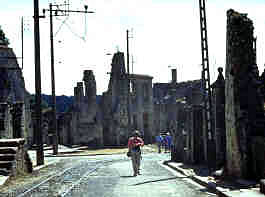 main street. Tracks of the tram ran down a side of the street.
Electrical wires that carried no electricity hung limply over
the tracks. The silence was complete.
main street. Tracks of the tram ran down a side of the street.
Electrical wires that carried no electricity hung limply over
the tracks. The silence was complete.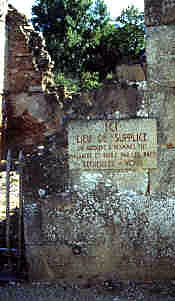 Most
poignant were the buildings where villagers were confined to
await their deaths: Laudy's Barn, Beaulieu's shed, Denys wine
and spirits store, Milord's barn, the Desourteaux Garage,
Bouchoule's Barn. The church, roofless but swept clean and tidy,
showed no evidence of the hundreds of women and children who
died there. The tower bell that melted in the inferno and fell
to the floor is there still. The sign on the outside wall
reminds visitors that this is a sacred place.
Most
poignant were the buildings where villagers were confined to
await their deaths: Laudy's Barn, Beaulieu's shed, Denys wine
and spirits store, Milord's barn, the Desourteaux Garage,
Bouchoule's Barn. The church, roofless but swept clean and tidy,
showed no evidence of the hundreds of women and children who
died there. The tower bell that melted in the inferno and fell
to the floor is there still. The sign on the outside wall
reminds visitors that this is a sacred place.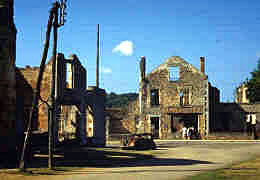 As
visitors began to appear and stroll about the fairground, we
turned and walked through neatly trimmed lawns and gardens to
the state memorial. The French Government erected the memorial
to house the remains of the victims. But it was not to be.
As
visitors began to appear and stroll about the fairground, we
turned and walked through neatly trimmed lawns and gardens to
the state memorial. The French Government erected the memorial
to house the remains of the victims. But it was not to be.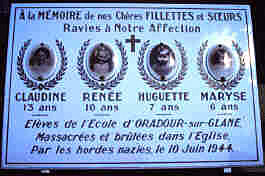 plaques
on graves were moving, telling of the destruction of entire
families, a whole school class, five brothers and sisters. After
such reminders of the violence and loss visited upon Oradour,
the signs everywhere are not needed: "Silence,"
"Remember."
plaques
on graves were moving, telling of the destruction of entire
families, a whole school class, five brothers and sisters. After
such reminders of the violence and loss visited upon Oradour,
the signs everywhere are not needed: "Silence,"
"Remember."
|
|